
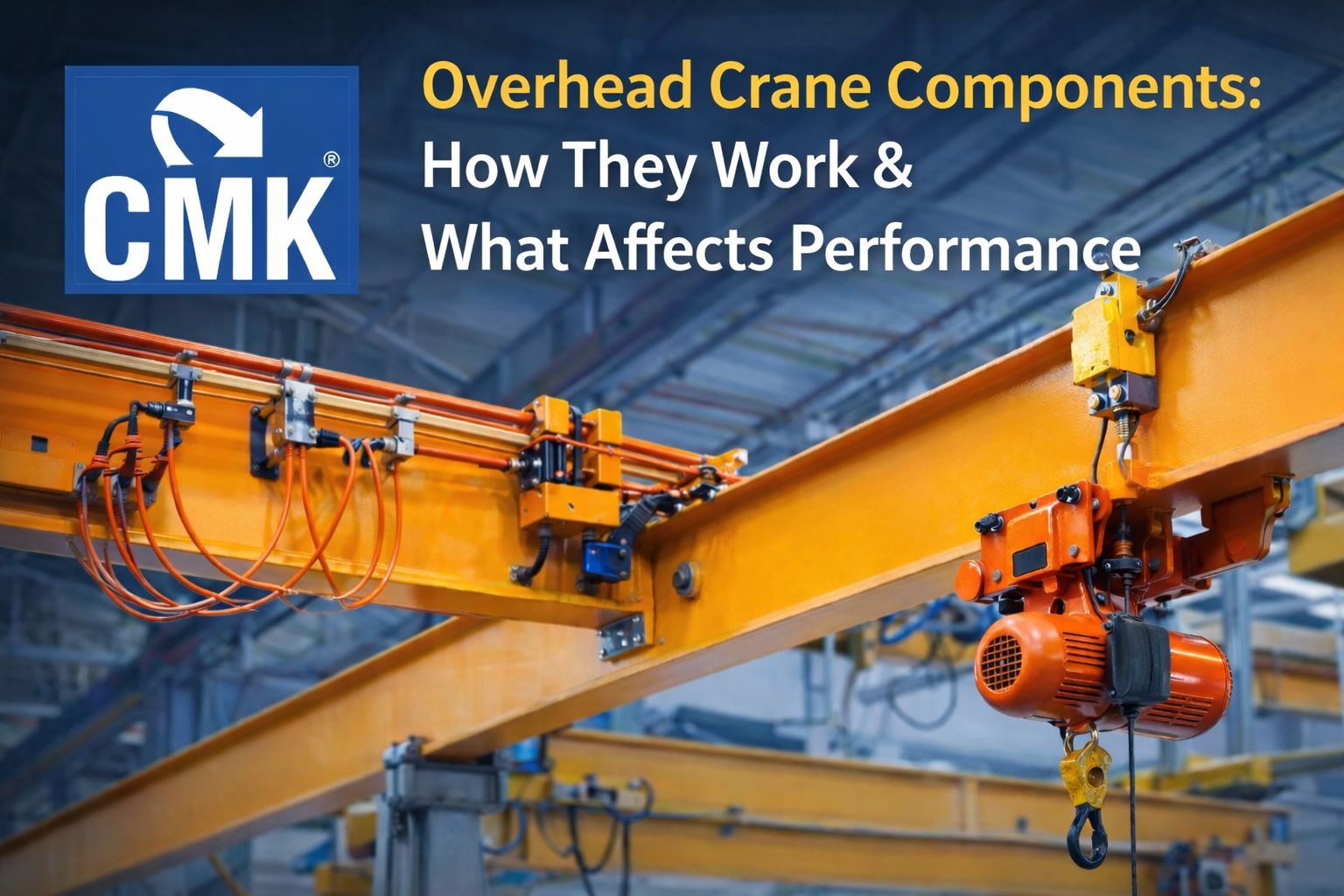
In every modern industrial facility, overhead cranes operate as the silent force behind material movement — lifting steel coils, positioning machinery, feeding production lines, and handling loads that define a plant’s efficiency. But their performance depends heavily on the quality, design, and engineering of the overhead crane components that operate behind the scenes continuously.
As industries demand greater uptime, higher safety standards, and more controlled lifting operations, the reliability of these components has never been more critical. This is where CMK India plays a valuable role in the ecosystem, supplying robust crane electrification systems, safety components, and mechanical parts that support smooth and safe crane operation across steel, power, chemical, automobile, and logistic industries.
Understanding how these components function — and what influences their performance — helps industries to make better decisions when choosing cranes, maintaining them, and planning their operation over the long run.
Understanding the Function of Overhead Crane Components
An overhead crane may appear to move effortlessly across a shop floor, but its operation is the result of many independent systems operating in harmony. Each component is engineered for a specific purpose: transmitting power, managing motion, protecting the load, or enabling operator control.
When even one component underperforms, the crane’s entire workflow can be compromised. This makes it essential to understand the functionality of these components individually and as part of a unified system.
1. Busbar Systems – The Crane’s Power Highway
Every overhead crane relies on a clean, uninterrupted flow of electricity, and the busbar system acts as the dedicated highway that supplies this energy. Instead of relying on flexible cables that sag, twist, or wear out, busbars offer a rigid, stable pathway designed for continuous motion.
What truly affects their performance is not just the material they’re made from, but how well they handle temperature, dust exposure, and mechanical vibration. In heavy-duty plants, even small defects in insulation or alignment can cause flickering power, overheating, or unexpected crane stoppages. A well-installed busbar system makes the crane feel “weightless”—moving smoothly and predictably regardless of load.
2. Current Collectors – The Moving Connector Behind Every Lift
If the busbar is the highway, the current collector is the vehicle that draws power as the crane moves along it. The collector’s role looks simple from the outside, but its engineering defines how reliably the crane receives electricity while in motion.
Collectors face constant friction, environmental exposure, and repetitive travel cycles. Their performance is influenced by spring tension, contact surface quality, and the ability to maintain pressure on the conductor bar without sparking. When constructed with precision, the crane accelerates and brakes smoothly. When they are not – operators observe jerks and dropped, and inconsistent responses.
3. Festoon Systems – The Organized Pathway for Cables
While festoon systems are often overlooked, they are essential for reliability of cranes. These systems direct the cables in an ideal choreographed path, allowing the trolley to move freely without stressing the cables.
What affects performance of festoon most is cable weight, track positioning and trolley bearings quality. Over time, even small misalignments can cause snagging, cable twisting, or premature wire damage. When engineered well, festoons behave almost silently — gliding across rails without resistance, keeping cables protected through thousands of travel cycles.
4. Limit switches – The Brain That Knows When to Stop
Limit switches act like the crane’s internal intelligence system. They don’t lift loads, but they ensure lifts happen safely by defining absolute boundaries for motion. Their job is to sense and stop movement before the crane enters an unsafe area — preventing the hoist from rising too high, the trolley from reaching the girder end or the crane from colliding with a wall.
What influences their performance? Sensitivity, calibration, and durability. A well-calibrated switch feels like a trusted co-pilot — intervening exactly at the right moment. A worn-out switch, however, creates hesitation, delayed stops, or unpredictable behavior, increasing risk significantly.
5. Braking Systems – The Control Behind Every Movement
While motors drive the crane, brakes control it. A crane may lift tons of material, but unless it has a responsive braking system, all the movements will be unsafe. Brakes are responsible for keeping the loads stable, avoid sudden stops and safely position the crane in case of power failure.
Performance is affected by brake lining wear, heat buildup, and the precision of actuation. In high-duty environments, brakes face intense pressure during every lift cycle, making their health one of the biggest factors in crane reliability and operator confidence.
6. Mechanical Components – The Backbone of Crane Stability
The mechanical elements — rope drums, couplings, wheels, rails, and end stops — form the crane’s physical foundation. These are the parts that take on the crane’s structural and load-bearing responsibilities.
Their performance is shaped by metallurgy, the accuracy of machining and their ability to resist stress and fatigue over time. In heavy industries, where cranes run continuously, these components determine whether the crane operates effortlessly or struggles with vibration, misalignment, and uneven movement.
What Affects the Performance of Overhead Crane Components?
Understanding how components work is one part; recognizing what impacts their performance is equally important. Several factors influence how long overhead crane components last and how well they perform:
1. Environmental Conditions
Dust, heat, humidity, chemical vapors and particulate matter affect electrification and mechanical parts differently. The harsher the environment, the more critical material selection becomes.
2. Load Characteristics and Duty Cycles
Continuous lifting, frequent start-stop cycles, or overloads put stress on busbars, brakes, limit switches, and rope drums.
3. Installation Quality
Even the best components underperform if misaligned, loosely fitted or poorly calibrated.
4. Maintenance Practices
Routine inspection of collectors, brakes, switches, and festoon trolleys significantly increases operational life.
5. Component Engineering and Manufacturing Quality
machining precision, insulation quality, and design integrity all influence performance — which is why industries prefer components engineered for industrial realities.
Where CMK India Fits Into This Ecosystem
By supplying durable, industry-tested overhead crane components, CMK India supports crane OEMs and industrial plants with electrification systems, safety components, and mechanical parts designed for long-term performance. Their components are engineered for tough environments and high-duty cycles, helping industries reduce downtime and maintain safer crane operations.
CMK’s role is not just supplying components — it is enabling dependable crane performance across India’s key industries.
Conclusion
Overhead cranes depend on a network of carefully engineered components — from busbars and collectors to limit switches and brake systems. Each component shapes the crane’s power delivery, movement accuracy, and overall reliability.
By understanding how these overhead crane components function and what affects their performance, industries can make informed decisions that enhance safety, reduce maintenance, and improve productivity.
And with reliable component partners supporting these systems, cranes become not just machines — but long-term assets that keep operations moving efficiently.
FAQs
1. What are the main components that make up an overhead crane?
2. What factors most commonly affect overhead crane component performance?
3. Why do busbars and current collectors matter so much in crane operation?
4. How do limit switches contribute to crane safety?
5. How can industries improve the lifespan of their overhead crane components?