
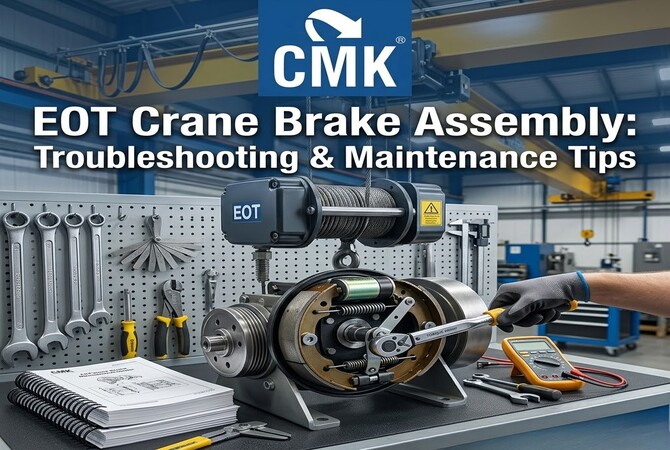
In heavy industrial environments, movement is power but control is safety. While motors lift, travel, and position loads across the shop floor, it is the EOT crane brake assembly that ultimately protects equipment, infrastructure, and human lives. A crane can only be considered reliable if its braking system performs flawlessly under load, under stress, and under emergency conditions.
In steel plants, manufacturing units, warehouses, and high-duty fabrication facilities, brake failure does not merely cause inconvenience. It risks load drift, structural stress, unexpected shutdowns, and serious safety hazards. Understanding the behavior, stress patterns, and maintenance requirements of the EOT crane braking system is essential for sustaining long-term operational reliability.
The Engineering Role of an EOT Crane Brake Assembly
A EOT crane brake system is a load control device that serves as a fail-safe appliance in industrial crane systems. In most configurations, electromagnetic or thruster brakes remain engaged by default and release only when energized. When electrical input is interrupted, the brake is activated automatically holding the suspended load at position.
This built-in fail-safe design ensures immediate load holding during power failure, controlled deceleration during routine stopping, stable positioning during precision lifting, and prevention of uncontrolled downward motion.
The braking torque should be accurately adjusted in terms of crane duty classification, load carrying capacity, and frequency of operation. If braking force is underestimated, the result can be load drift and positioning instability. Conversely, excessive torque may cause mechanical shock, increased vibration, and accelerated component wear. Brakes are not passive devices within the crane assembly, they are dynamic systems continuously responding to variations in load stress and operational demand.
Why Brake Assemblies Fail in High-Duty Operations
Unlike structural components, crane brake systems experience continuous friction-based stress. Heat generation is one of the primary contributors to wear. Each engagement produces thermal energy, gradually affecting friction linings and braking efficiency.
In heavy-duty cycles, especially in Class III and IV cranes, repeated start-stop patterns increase thermal fatigue. Over time, this may lead to:
- Glazing of brake linings
- Reduction in braking torque
- Uneven surface contact
- Micro-cracks in friction material
Environmental conditions amplify these stresses. Dust infiltration contaminates friction surfaces. Misalignment causes uneven pressure distribution. Vibration from motor assemblies gradually loosens mounting hardware.
Brake failure rarely occurs suddenly. It evolves silently through performance degradation.
Operational Warning Signs That Should Never Be Ignored
Experienced operators often detect brake deterioration before technical failure becomes obvious. Subtle changes in crane behavior reveal early-stage issues.
A drifting hook after stopping, slightly extended stopping distance, abnormal noise during engagement, or noticeable motor overheating are all indicators that the overhead crane brake assembly requires inspection.
Ignoring these signals leads to compounded stress. What begins as minor lining wear can evolve into torque instability, putting both load and operator at risk.
Advanced Troubleshooting Approach
Effective troubleshooting must go beyond visual inspection. A structured evaluation should include:
- Brake Lining Measurement – Verify wear limits and check for uneven surface patterns.
- Spring Tension Testing – Confirm that applied braking force matches the manufacturer torque specifications.
- Electromagnetic Coil Assessment – Measure coil resistance and insulation integrity to ensure reliable release and engagement.
- Alignment Verification – Check motor shaft alignment and brake housing positioning to prevent side loading.
- Thermal Inspection – Identify overheating patterns that indicate excessive friction stress.
Electrical inconsistencies should also be reviewed. Voltage fluctuation can delay brake release timing, causing jerky crane motion and increased mechanical strain.
Proper documentation of inspection data enables predictive maintenance rather than reactive repair.
Preventive Maintenance for Brake System Longevity
Preventive maintenance of an industrial crane brake system is not optional, it is strategic risk management. Inspection intervals should be aligned with crane duty classification and load cycles.
Best practices include:
- Periodic torque recalibration
- Cleaning of friction surfaces to remove dust contamination
- Monitoring bolt tightness under vibration conditions
- Checking coil voltage stability
- Replacing worn linings before reaching the minimum thickness
Lubrication must be applied carefully to designated mechanical parts only. Contamination of friction surfaces drastically reduces braking efficiency.
Facilities that treat brake inspection as a structured routine experience significantly fewer emergency breakdowns.
Lifecycle Optimization Through Component Quality
The long-term performance of an EOT crane brake assembly depends heavily on material engineering. High-quality friction lining, long-lasting springs, machined housings, and stable electromagnetic systems have a direct impact on the reliability.
Low-grade components may appear cost-effective initially but often lead to higher maintenance frequency and unpredictable downtime. Investing in engineered brake assemblies designed for high-duty industrial conditions ensures:
- Consistent braking torque
- Reduced thermal degradation
- Extended service intervals
- Improved operational safety
CMK India manufactures industrial-grade crane brake components engineered for durability and stable braking performance under demanding operational cycles. Their focus on material integrity and precision engineering supports safe and reliable crane operation across heavy industries.
Conclusion
The EOT crane brake assembly is not just a stopping device, it is the core safeguard of crane motion control. Its performance determines whether loads remain stable, whether movements remain precise, and whether emergency situations remain controlled.
Industries can greatly decrease downtimes and increase the life of brake assembly through identification of early warning, structural troubleshooting practices, as well as through disciplined preventive maintenance. Reliable braking is not simply a mechanical necessity; it is a critical pillar of industrial crane safety and operational continuity.