
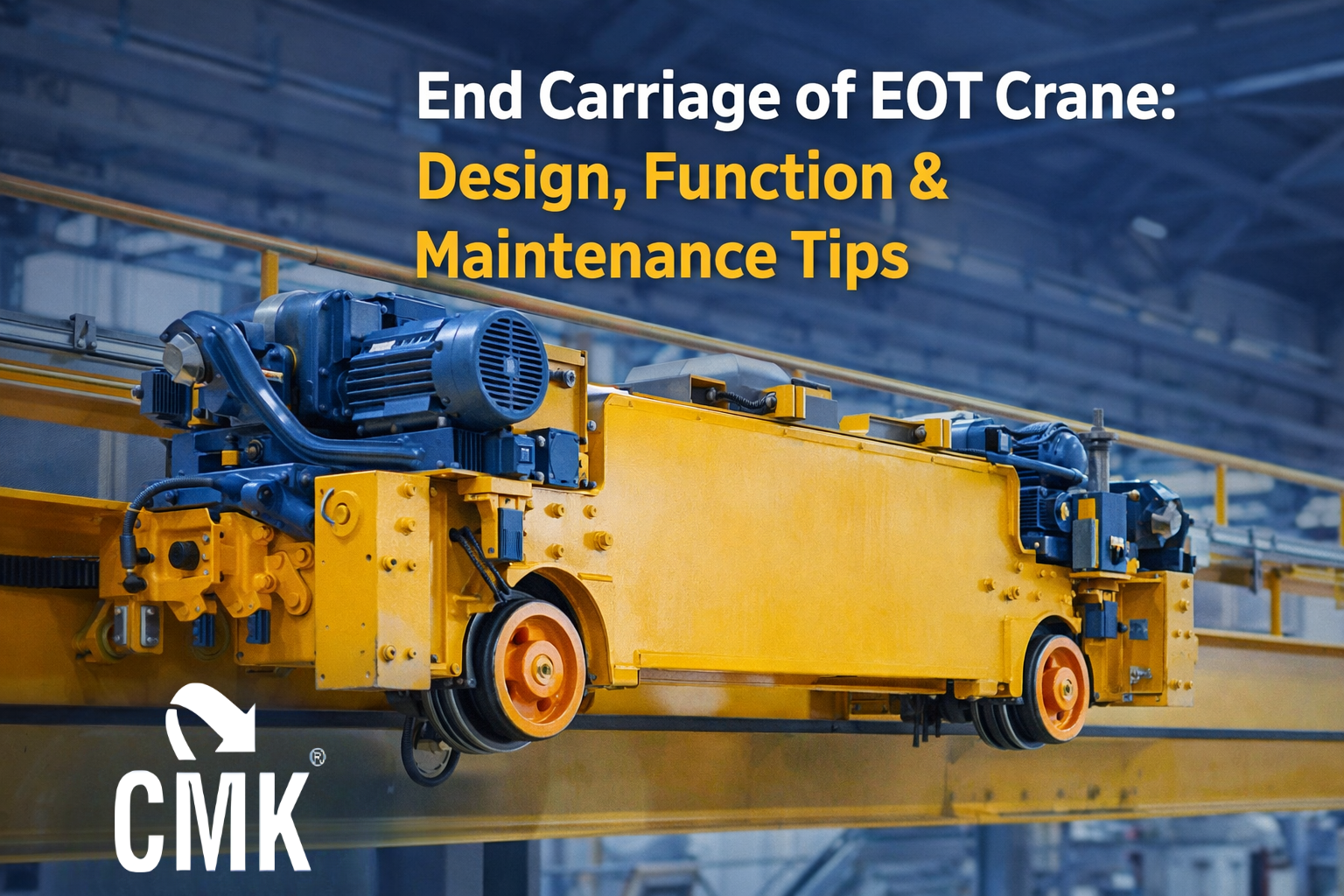
In an EOT crane system, lifting power may define capacity, but travel stability defines reliability. The end carriage of EOT crane forms the mechanical foundation that supports the bridge girder and enables controlled movement along the runway. It absorbs dynamic forces, distributes vertical and lateral loads, and maintains alignment under continuous operational stress.
When engineered correctly, the end carriage ensures smooth, vibration-controlled travel. When it is left unattended or improperly designed, it turns out to be the source of wear to the wheel flange, deformation of the rail, structural fatigue, and, in severe cases, derailment. In high-duty industrial environments, the end carriage is not merely a supporting element, it is a precision load-transfer system.
Engineering Design of the End Carriage of EOT Crane
The EOT crane end carriage is mounted at both ends of the bridge girder and typically consists of a fabricated steel frame, wheel assemblies, bearing housings, travel motors, and gear couplings. Its primary engineering objective is to transfer vertical and horizontal loads safely onto the crane runway.
Load transfer occurs in two directions:
- Vertical load from lifted weight and girder mass
- Horizontal thrust generated during acceleration, braking, and skew
Wheel design plays a crucial role. Flanged wheels must maintain parallel alignment to the rails to prevent lateral thrust. Improper machining tolerances or installation misalignment can cause skewing, a condition where the crane travels slightly diagonally, increasing flange wear and rail stress.
Precision in fabrication and alignment is critical. Even minor dimensional deviation can multiply under dynamic load conditions.
Functional Role in Crane Travel Stability
The overhead crane end carriage is responsible for converting motor-driven torque to stable long-travel motion. Travel motors transmit rotational energy through gear assemblies to the wheel shafts, enabling controlled movement across the runway.
However, movement alone is not the primary concern. Stability under load is critical. Uneven weight distribution across wheels can lead to excessive stress concentration on a single wheel, causing premature wear and imbalance. Similarly, sudden torque application during braking introduces shock loads into the structural frame.
The end carriage must therefore balance strength and precision. It supports the crane girder, maintains alignment accuracy, and ensures that motion remains smooth even under repetitive high-duty cycles.
Typical Failure Patterns in Industrial Applications
Unlike hoist failures, end carriage deterioration develops gradually. Misalignment, bearing wear, and vibration typically begin as minor performance irregularities before escalating into mechanical instability.
The most common stress-related concerns include uneven wheel wear, bearing overheating, loosening of structural fasteners due to vibration, and increased lateral pressure caused by rail misalignment. Over time, these issues can compromise runway integrity and lead to costly structural repairs.
Because the end carriage interacts directly with the runway, rail condition becomes a critical influencing factor. An uneven or improperly leveled rail system amplifies stress within the carriage assembly, accelerating fatigue.
Precision Maintenance for Long-Term Performance
Maintaining the end carriage of EOT crane requires disciplined inspection and alignment verification rather than simple visual checks. Precision measurement techniques are essential to prevent progressive damage.
Maintenance programs should focus on verifying wheel parallelism, checking diagonal measurements to detect skew, monitoring bearing vibration levels, and inspecting gear coupling alignment. Structural bolt torque must be assessed periodically to prevent frame distortion under repeated travel cycles.
Among these practices, alignment verification stands out as the most critical preventive step. Ensuring that wheel axes remain parallel to the runway significantly reduces flange wear and structural stress.
When Overhaul Becomes Necessary
Persistent vibration, visible flange thinning, repeated derailment tendencies, or structural cracking indicate that the crane end carriage assembly may require overhaul or replacement. Delaying intervention in such cases often results in secondary damage to rails, drive systems, and even the bridge girder.
Using precision-machined, high-strength assemblies designed for heavy-duty operation restores proper load distribution and extends overall crane lifespan.
CMK India manufactures robust industrial crane components, including accurately engineered end carriage assemblies built for demanding applications. Precision fabrication and structural integrity play a decisive role in maintaining safe and stable crane travel.
Conclusion
The end carriage of EOT crane is the anchor of crane mobility and structural alignment. Its design determines how loads are transferred, how smoothly the crane travels, and how effectively the system resists vibration and skew.
By combining precision engineering with disciplined alignment checks and preventive maintenance, industries can significantly extend crane service life and reduce travel-related downtime. In any high-duty operation, the health of the end carriage directly reflects the overall reliability of the crane system.